Numb & Diagnose
We take a digital X-ray to see how far the infection has spread, then numb the tooth completely. If you're anxious, ask about sedation — nitrous oxide and other options are available on the same visit.

A root canal stops the throbbing, clears out the infection, and saves a tooth that would otherwise have to come out. At Village Dental — Olde Raleigh, most cases are finished in one or two comfortable visits with sedation available if you need it.

A root canal is the treatment that finally stops the kind of tooth pain that keeps you up at night — the throbbing, the sensitivity to hot and cold that lingers, the ache that radiates into your jaw. The infection is inside the tooth, in a thin strand of nerve and blood vessel called the pulp. We numb the area, make a small opening, clean the infection out, seal the inside, and the tooth is saved.
Most of the people we see for root canals in Olde Raleigh, Raleigh, NC are not in chair number one for a routine check-up — they are calling first thing on a Monday after a weekend that got worse and worse. We get patients from Olde Raleigh, West Raleigh, Crabtree Valley, North Hills, Cary, and the neighborhoods just off the I-440 and Glenwood Avenue corridor who waited as long as they could and finally couldn't. We hold same-day windows daily for exactly this reason. Whether the pain started after a cracked filling, a deep cavity, or a knock to the mouth, the path forward is usually the same — confirm it with a digital X-ray, and treat it that day if we can.
The alternative to a root canal is a tooth extraction, and once a back tooth is gone you'll want to replace it with a dental implant or a bridge to keep your bite from drifting. That ends up costing more than saving the natural tooth and almost always takes longer. A root canal followed by a permanent crown is usually the right call when the tooth is still structurally sound — and we'll tell you straight if it isn't.
One or two visits, full numbing, sedation if you want it — and the pain is gone before you walk out.
We take a digital X-ray to see how far the infection has spread, then numb the tooth completely. If you're anxious, ask about sedation — nitrous oxide and other options are available on the same visit.
Through a small opening in the top of the tooth, we remove the infected pulp and shape the canals with fine rotary instruments and an antibacterial rinse. This is the step that actually stops the throbbing.
The cleaned canals are filled with a biocompatible sealer and the access opening is closed. Most back-tooth root canals then get a permanent crown a couple of weeks later to protect the tooth from cracking under chewing pressure.
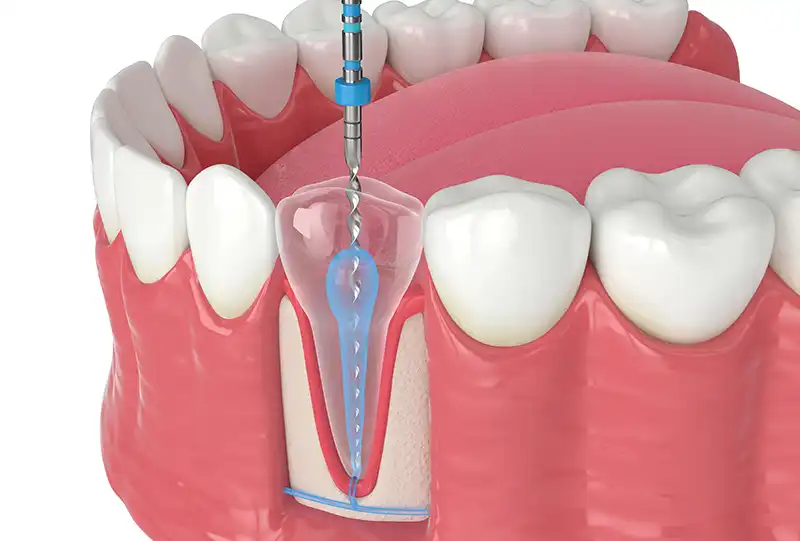
The reputation root canals carry — slow, painful, dreaded — is from a generation ago. Today the canals are shaped with flexible nickel-titanium rotary files instead of hand reamers, the working length is confirmed electronically with an apex locator instead of repeated X-rays, and the canal is disinfected with irrigants and ultrasonic activation. The result is a procedure that feels closer to a deep filling than the surgery it used to be.
Before any work starts, we use intraoral cameras and digital X-rays to show you exactly what we're seeing on a screen — the dark area at the tip of the root, the crack, the deep cavity that finally hit the nerve. For molars with curved or hidden canals, we use 3D cone-beam imaging (CBCT) so nothing gets missed. You'll see the same image we're working from, and we'll talk through whether a root canal plus a crown is the right call or whether the tooth is too far gone and an extraction makes more sense.
A few practical notes for Olde Raleigh, Raleigh, NC patients. We hold same-day windows every weekday for tooth-pain emergencies, so a call first thing in the morning usually gets you seen the same day. We're a judgment-free office — if you've been putting this off because you were embarrassed about how long it had been, that's why we're here. We quote the price up front in writing so you know what insurance is covering and what isn't before we start. And we keep the office at Village Dental — Olde Raleigh close enough to home that follow-up visits aren't a half-day commitment.
The price of a root canal depends mostly on which tooth is involved. Front teeth have one canal and are the simplest, while molars have three or four canals and take more time, so they cost more. Most root canals also need a permanent crown afterward, which is a separate fee. Insurance typically covers a meaningful portion because a root canal is medically necessary, not cosmetic. We'll give you a written estimate before any work starts. Village Dental — Olde Raleigh is in-network with the major dental insurance providers below.




Please note: We do not accept Medicaid. If you're uninsured, ask about the Village Dental Membership Plan — it bundles your preventive visits and gives you a discount on additional treatment, including root canals and follow-up crowns.
New patients: Your first exam and X-rays are free. If you've been holding off on a tooth that's been bothering you, that's an easy place to start.
Right off I-440 and Glenwood Avenue on Edwards Mill Road in West Raleigh — minutes from Crabtree Valley and easy to reach from North Hills, Cary, and RTP. Same-day root canal appointments are often available when there's an opening on the schedule.
It depends on the tooth. A front tooth has one canal and is the simplest case; a molar has three or four canals and takes longer, so it costs more. Most root canals also need a crown afterward, which is a separate cost. We're in-network with Delta Dental Premier, Cigna PPO, BCBS Grid, and United Concordia Elite, and we give you a written estimate before treatment begins. We do not accept Medicaid. Call (919) 912-2193 for a quote.
Village Dental — Olde Raleigh, at 3101 Edwards Mill Rd #103, holds same-day appointment windows daily for tooth pain and emergencies. If a tooth is throbbing, swollen, or keeping you up at night, that's the kind of case we try to fit in the same day. Call (919) 912-2193 first thing in the morning to grab the earliest open slot.
A front-tooth root canal is usually one visit of 60 to 75 minutes. A molar with multiple canals can run 90 minutes to two hours, sometimes split across two visits if the infection is heavy. The permanent crown that finishes the back-tooth cases is a separate appointment, typically a couple of weeks later. Call (919) 912-2193 if you want a more specific estimate for your tooth.
No. The pain people associate with root canals is the infected tooth itself, not the procedure. We numb the tooth fully before any work starts, so during the appointment you'll feel pressure but not pain. Most patients walk out feeling significantly better than they walked in. Mild soreness for a day or two afterward is normal and usually controlled with ibuprofen. Call (919) 912-2193 with questions.
Most dental plans cover a meaningful portion of a root canal because it's a medically necessary procedure to save a tooth. We're in-network with Delta Dental Premier, Cigna PPO, Blue Cross Blue Shield Grid, and United Concordia Elite, and we verify benefits before treatment so the out-of-pocket cost is clear up front. We do not accept Medicaid. Call (919) 912-2193 with your insurance card handy.
Saving the natural tooth with a root canal is almost always the better long-term option. Pulling a tooth feels cheaper in the moment, but the gap then needs to be filled with a bridge or a dental implant to keep neighboring teeth from drifting and the bone from shrinking. A root canal plus a crown usually costs less and looks and chews like a real tooth. Extraction is the right call when a tooth is cracked below the gum line or no longer restorable. Call (919) 912-2193 for a straight evaluation.
A root canal followed by a properly placed crown commonly lasts 15 years or more, and many last for life. Avoid chewing on the tooth until the permanent crown is placed, and skip ice and hard candy long-term — a hollowed-out tooth without a crown can crack. Brush, floss, and come in for cleanings every six months, and the treated tooth should keep working like the rest of your smile. Call (919) 912-2193 if you ever feel new pain or pressure on a tooth that had a root canal.
The most common signs are lingering pain when you bite down, sharp sensitivity to hot or cold that doesn't go away, a tooth that has darkened, a small bump on the gum near the tooth, or visible swelling. A digital X-ray and a quick exam will confirm whether the nerve is involved. Not every painful tooth needs a root canal — sometimes a deep filling or crown is enough. Call (919) 912-2193 to be evaluated.
Yes. Village Dental — Olde Raleigh sits just off I-440 and Glenwood Avenue at 3101 Edwards Mill Rd #103 — minutes from Crabtree Valley and an easy drive from North Hills, Cary, and RTP. Same-day windows are reserved daily for tooth pain, so a Crabtree Valley or Cary patient calling in the morning can usually be seen the same day. Call (919) 912-2193.
Yes. We offer nitrous oxide (laughing gas) and other sedation options for patients who are nervous about dental work. Nitrous wears off within minutes after the appointment, so most patients drive themselves home. If a deeper level of sedation is more appropriate, we'll talk through it during the consult. The goal is for the appointment to be the easy part of an already rough week. Call (919) 912-2193.